Sunday, October 31, 2010

Blog Post #9-Film Structure

The most Hollywood movies follow the 3 act structure. The structure of the first act of the movie Aliens, directed by James Cameron,  revolves around the soldiers going to the terraforming colony to find what happened to the communications with the colonists and find survivors. The beginning of the movie develops with Ripley agreeing to be a consultant amongst the soldiers and their skepticism about her story. Plot point one occurs at about 45 min 45 seconds when they discover the survivor Newt.  This escalates the stakes because they now have a child to protect which leads to complication within the fabula. The question now is how the soldier are going to survive on the planet and how they are going to complete their mission.
The next act involves Burke attempting to make hosts of Ripley and Newt. After his betrayal, Corporal Hicks makes the decision along with Ripley to destroy the base to kill the aliens. After an alien boards their ship killing the pilot, the plant begins to go on meltdown. The next question is how they are going to avoid the nuclear explosion and get back to Earth. Plot point two occurs at about 1 hour 15 min.
The last act and climax occur as Ripley tries to save Newt from the Queen alien and get to the ship before the base explodes. The climax occurs at 2 hours 11 min when Ripley causes the Queen to be shot from the air duct and into space. There is the happy ending of peace when they go into hyper sleep and are now safe.

Sunday, October 24, 2010

Blog #7: The TV Sitcom

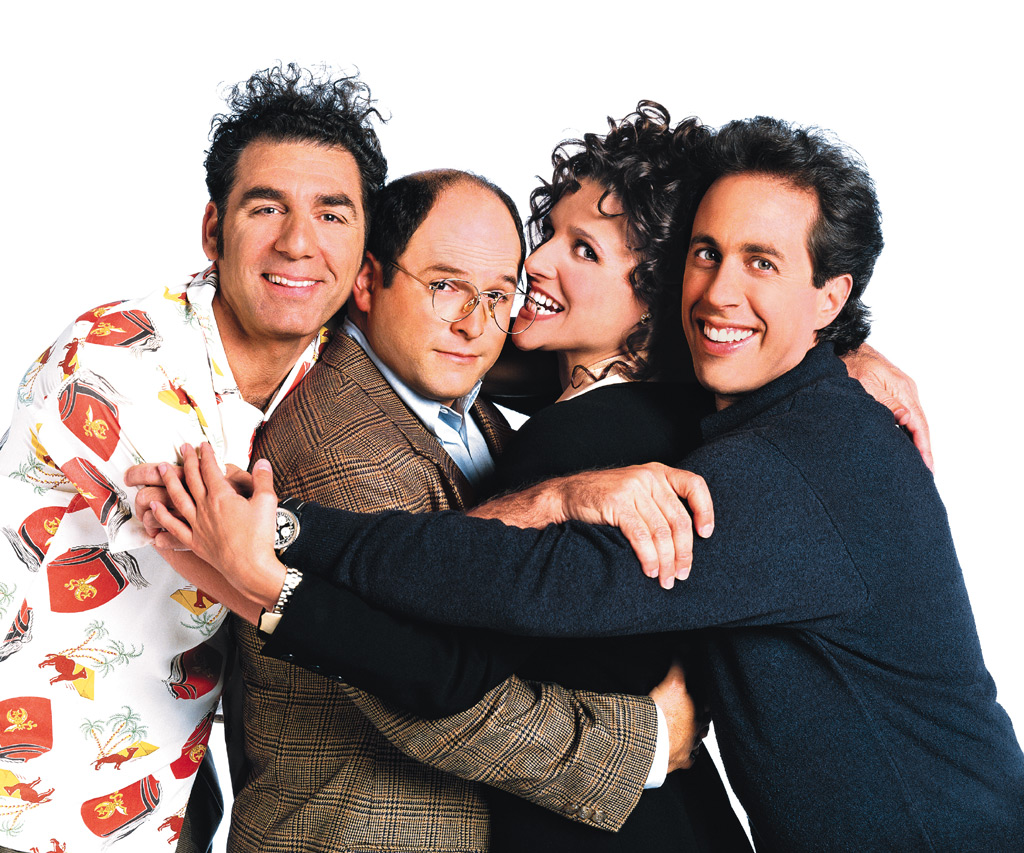
The television sitcom was born of Classical Hollywood qualities. Certain aspects of filming were retained such as establishing and retaining strong character and the use of mise-en-scene. Character development is a focal point for sitcoms. Just as during the Golden Age of Hollywood, maybe not so much actor names, specific characters are a draw for audiences. In sitcoms, characters rarely change and if they do it is over the course of a season or perhaps at the end of the series. Mise-en-scene is a focal aspect of sitcoms that gives them their staged quality. Because they are filmed in the proscenium style, the sets of sitcoms tend to be centered in a living space where characters interact within the frame while others occupy themselves until they are needed. The show Seinfeld exemplifies these aspects.


Seinfeld is heavily character-based. Jerry Seinfeld never changes throughout the course of the show, even when there is a glimpse of character development it is soon overwashed by something funny. As a comedian playing himself as a comedian, there is a self-reflexive quality as well. Jerry is neat and witty. George Costanza is uptight, cheap, insecure and selfish. Elaine Benes is superficial and bluntly spoken. Cosmo Kramer is quirky, laid back and inventive. As a collective, they act as children: often they resort to playing games to settle quarrels, physically fighting and teasing each other. There are moments of clarity such as when Jerry and George fall in love and decide to give up their bachelor ways, yet by the next episode they have changed their minds and try to figure out ways to get out of their relationships.


The majority of the show is set in Jerry's apartment and filmed in front of a live audience which gives these scenes a theatrical quality. The action remains in the living room area which is openly attached to the kitchen. The mise-en-scene is especially noticeable, for example, when George is watching television while Jerry and Elaine stand in the kitchen chatting or eating. During different episodes there is the realistic quality of characters entering and leaving the apartment or going to Jerry's room/bathroom while others interact in the main living area.

source: Google images

Sunday, October 17, 2010

Blog Post #6-Shot meanings Terminator 2

One of my favorite movie moments is the short scene from Terminator 2 when Linda Hamilton is trying to escape from the mental hospital and sees ArnolSchwarzenegger coming out of the elevator:  time 1:00:40 to 1:01:10. From the beginning to the end, James Cameron utilizes different camera angles and slow motion to show the range of emotions that Hamilton's character, Sarah Connor, experiences.

There is a LS used when in the foreground the elevator door is opening and Hamilton is down the hall. Her full body can be seen which helps show her excited body language. Meaning that can be taken from this LS is that she is vulnerable and alone. The angle emphasizes the danger she is in and that she has only herself for protection. It also shows her as small when in comparison to the low angle, CU shot of Schwarzenegger which occurs within the next 2 shots.

There are several MS shots during this scene of Hamilton running away from Schwarzeneggeer: one that particularly stands out is when  he first is seen walking out of the elevator with his face in profile. It is important because it catches her off-guard since he is still far enough away to barely recognize him. Because of his clothing and the shotgun, the audience recognizes that it is him. The MS shows his deliberate manner of walking and this allows him to appear inhuman. It sets up the next shot of Schwarzenegger in a CU.

The CUs that stand out are the CU of Schwartzenegger's face after a CU of Hamilton's when he comes out of the elevator. The CU of Hamilton serves to show her recognition of Schwartzenegger and his CU serves to confirm that he has not changed since she last saw him. There is a clear juxtaposition as her face is panicked while his is stoic and emotionless. It heightens the contrast of their characters and the intensity of the scene.

Sunday, October 10, 2010

5th Blog Post: Star System

An aspect of how the studio system worked was through the star system which was a result of contracted talent. Classical Hollywood used a factory-based system where every aspect of production was vertically integrated. Along with distribution and exhibition control, studios contracted its talent and controlled what movies they were allowed to participate in. The star system derived out of audience demand for certain actors/actresses. Therefore, they were used to advertise and sell the movies.

Actors were also typecast within certain characters and genres that came to be expected in every movie that they were in. This affected the kinds of films made by the studios. Audience demand dictated what films the studios chose to make. For example, if westerns were becoming more popular then the film studios would begin to make more westerns. If certain actors were in demand then they would be contracted to make several movies within the year.


Buster-Keaton.gif

Buster Keaton is an example of an actor/talent that was under the influence of the star system. He worked under MGM which limited his creativity and ability to create the movies he wanted to make. He came to be known as "the great stone face" because of his character that showed little emotion that was in every film he made. His films had the trend of being about an ambitious and naive character caught in a chaotic situation/world. His films were all comedic in nature.

The star system turned actors into products that could be advertised and sold. This is explains the high distribution of movies that contained the same basic formula.


(image: google.com/images)

Sunday, October 3, 2010

4th Blog Assignment- "All in the Family" compared to" Arrested Development"

All in the Family and Arrested Development are family-based situational comedies that hold characteristics that make them both similar and different.

While Arrested Development is much more pronounced in its audacity to show taboo attitudes and behaviors, All in the Family takes on the issue of homosexuality with a realistic approach. All in the Family uses Archie Bunker's character to illuminate the common prejudices against homosexual men in an ignorant light by his use of demeaning name calling. Where his hostility creates tension amongst the audience for the honesty of his character, the openness of his personal opinion is contested between his family. Arrested Development pursues this subject matter in a purely comic light. The character Tobias is constantly acting in a suggestive manner that makes him seem gay without him realizing it. He consistently spouts innuendos without realizing they could be easily and obviously taken out of context. While All in the Family is more shocking because of the reality of Archie's mindset, Arrested Development treats the situation unabashedly.

 These two shows could be considered complementary, because they pursue a disapproved topic. Both attempt humor and show dysfunction within a "superficially normal" family. There is also the fact that the older generations are opposed to the "homosexuals" in the shows. For example, in All in the Family Archie berates his son's friend behind his back with insults and in Arrested Development both of Lindsay's parents disapprove of her marriage to Tobias because he acts so strangely to them. Both shows are connected by their ability to point humor, whether considered offensive, in a direct way towards taboo subjects.

An issue that All in the Family dealt with that Arrested Development did not was that Archie, when he learned his long-time friend was indeed gay, changed his perception of people and may have grown as a character. Another fact is that Archie's friend was portrayed subtly whereas Tobias is much more obvious in his manner of speaking and dress. An issue that Arrested Development deals with that All in the Family  does not is that homosexuality is much more accepted in modern times. It also deals with the fact that closet homosexuals may marry to hide their true identities.